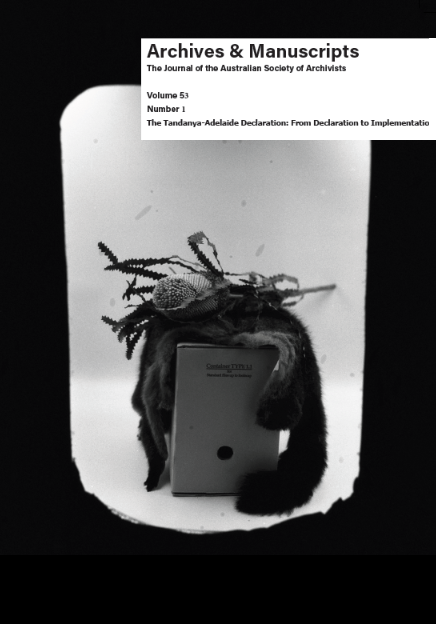
Implementing the Tandanya-Adelaide Declaration at the Australian War Memorial
Abstract
The archives of the Australian War Memorial (herein referred to as the Memorial) were established in 1917 with a national aim – to preserve as ‘sacred things’1 the records made by the Australian Imperial Force in the war of 1914–1918. Over time, the Memorial and its archives have expanded to include Australia’s involvement in earlier British Imperial wars to recent conflicts in Afghanistan and Iraq, and peacekeeping and humanitarian operations; however, the Memorial resisted, amidst intense national debate, the 40-year call for extensive coverage of the wars on Australian soil, by which Aboriginal and Torres Strait Islander peoples were violently displaced and colonised and the nation state of Australia was formed.
In September 2022, it was announced that the Memorial’s Council had made the decision that there would be ‘a much broader, a much deeper depiction and presentation of the violence committed against Indigenous people’,2 and in February 2023, it was confirmed that the Memorial would have ‘a proper recognition of the frontier conflict’ in its galleries.3 This is an important endeavour that requires unwavering implementation of research and curatorial best practice in relation to Aboriginal and Torres Strait Islander peoples’ knowledges, cultural material, intellectual property, and experiences of war, violence, discrimination and trauma.
As the Memorial seeks to open and develop its archives to support its forthcoming truth-telling, Memorial curators are working to implement the Tandanya-Adelaide Declaration (2019) (herein referred to as the Declaration) and Indigenous Cultural and Intellectual Property protocols to establish ‘an ethical space of encounter, respect, negotiation and collaboration’.
Copyright (c) 2026 Margaret Farmer

This work is licensed under a Creative Commons Attribution-NonCommercial-NoDerivatives 4.0 International License.
From 2022 (Volume 50) authors contributing to Archives & Manuscripts agree to publish their work under the terms of the Creative Commons Attribution-NonCommercial-NoDerivatives License), which permits non-commercial re-use, distribution, and reproduction in any medium, provided the original work is properly cited, and is not altered, transformed, or built upon in any way. Authors retain copyright of their work, with first publication rights granted to A&M.